


2025 NBA Finals: Thunder and Pacers are the modern blueprint of what winning looks like
June 3, 2025 at 5:41 PM UTC·8 min read
As the NBA Playoffs progress, it becomes increasingly clear: if a player can’t shoot or defend, they’re getting exposed, and their team is likely to be eliminated. The traditional 3-and-D player who stands in the corner isn’t enough anymore. Today’s players must be able to dribble and make quick decisions.
This is why the Boston Celtics won the title last year. They had stars in Jayson Tatum and Jaylen Brown, but they also surrounded them with well-rounded pieces. When Tatum and Brown were on the floor with Derrick White, Jrue Holiday, and Al Horford, everyone could shoot, make reads, and defend. There were no weak links, even on the bench.
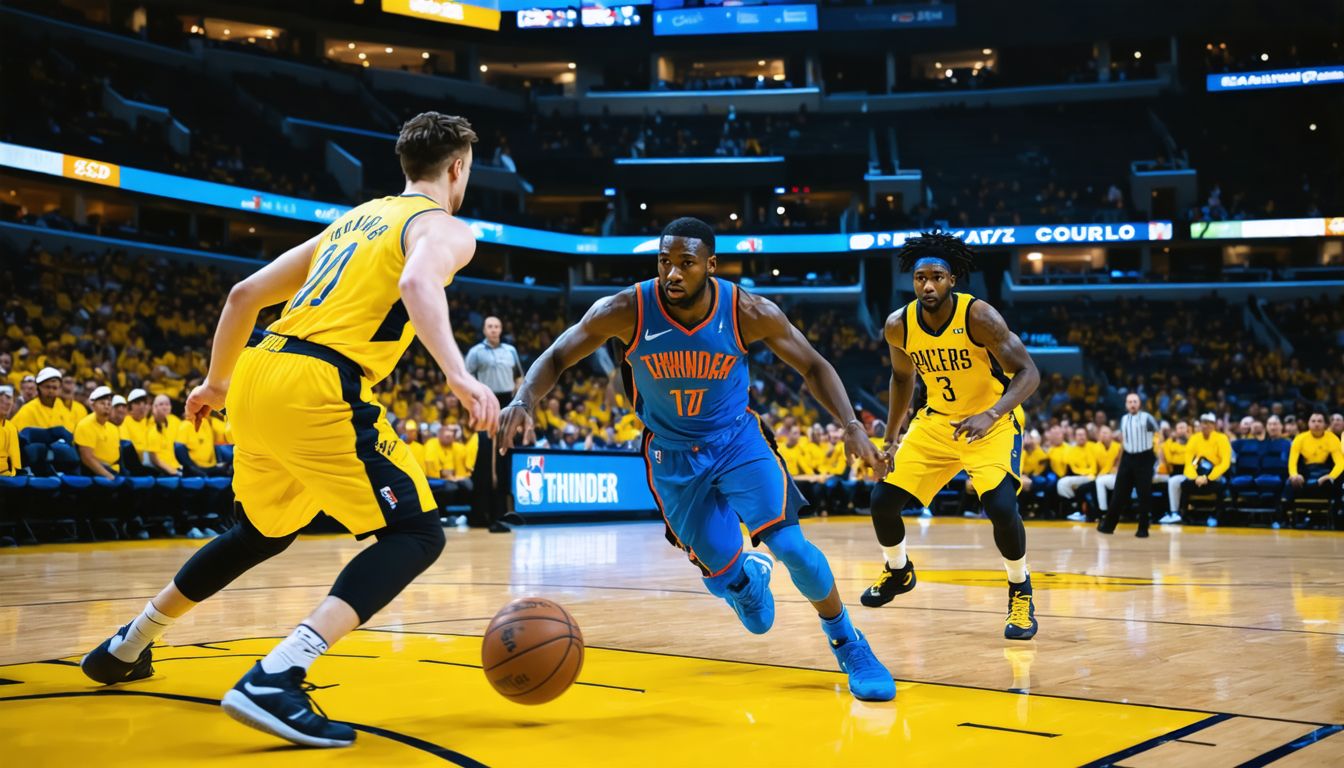
This season, the Oklahoma City Thunder and Indiana Pacers are following a similar blueprint in the NBA Finals. Shai Gilgeous-Alexander, Jalen Williams, and at least one of Lu Dort, Alex Caruso, or Cason Wallace have shared the floor for 88% of Oklahoma City’s playoff minutes. In 176 of those minutes, at least four of them have played together, and the Thunder have outscored opponents by a staggering 18.1 points per 100 possessions. Each of these players can defend, process the game quickly, and create offense.
SGA is the hub, but OKC’s success depends on everyone else fitting into the system. Dort cuts, Wallace connects, Caruso makes instant reads. There’s no ball-stopper, no spacer who can’t dribble, no defender the Thunder can’t trust. Even OKC’s bigs fit the mold: Chet Holmgren can shoot, pass, and handle, and while Isaiah Hartenstein doesn’t shoot 3s, he plays with elite feel as a finisher and facilitator.
Indiana functions similarly. Tyrese Haliburton is their engine, but the pieces around him—Andrew Nembhard, Aaron Nesmith, Pascal Siakam, and Myles Turner—are all skilled enough to play with tempo, precision, and relentless energy. They all shoot well: Nembhard, Nesmith, Siakam, and Turner are all shooting over 40% from 3 on over three attempts per game in the playoffs. Everyone can contribute in this system. Nesmith had his all-time hot streak to fuel a historic Pacers comeback in Game 1. Siakam went off for 39 in Game 2 and 31 in Game 6 against the Knicks, winning himself East Finals MVP. Nembhard has had separate games with over 20 points and over 10 assists while playing lockdown defense. Even with bench units featuring T.J. McConnell and Thomas Bryant, the Pacers can go on a scoring flurry.
Their historic comebacks break the mold too. The Pacers don’t turn to clear-out, hero-ball isolations. They stick with their flow: pace, movement, and speed. In the moments that most teams tighten up, Indiana just keeps running its offense.
The throughline with both teams is clear: there are no dead zones, everyone is a threat. It’s a roster with continuity and a system built on interchangeable skill sets, rapid processing, and nonstop effort. And two excellent coaching staffs led by Mark Daigneault and Rick Carlisle who constructed these systems and devised game plans to unleash their players’ strengths.
We’ve seen prototypes before, like the Beautiful Game Spurs, and the Warriors dynasty. But today’s shift is a product of how the game has evolved. Pace is at an all-time high. So is spacing. A record-high 42.1% of shots were taken from 3 this season, and they were launched from farther than ever before: 26.2 feet on average above the break. Screens are also being set farther from the hoop: the average on-ball screen came 25.7 feet from the rim, another all-time high. Defenses are switching more than ever: 24.6% of the time this year, up from just 7.7% a decade ago and 15.8% a half-decade ago.
All of that means defenders have to cover more ground and do it faster than ever. Every offensive possession stretches the floor horizontally and vertically. On top of that, playoff officiating has made the game more physical than it’s been in decades. Players have to be tough enough to absorb contact and relentless enough to fight through every screen, closeout, and rotation. That’s part of why the Thunder and Pacers have made it this far. Both teams are deep with guys who meet those demands. Teams with shorter benches run